

A prop trading evaluation without minimum trading days gives traders more control over their schedule. If the required profit target is reached quickly and every risk rule is respected, there may be no need to place additional trades simply to satisfy a calendar requirement. For swing traders, selective intraday traders, and people who prefer waiting for high-quality setups, this flexibility can be a meaningful advantage.
However, “no minimum trading days” does not automatically mean that an evaluation can be passed in one day. Consistency rules, profit targets, drawdown limits, account reviews, and other qualification conditions may still affect the earliest possible completion date. Some firms also remove minimum-day requirements only after the trader receives a funded account, not during the challenge itself.
This guide compares five prop trading providers and explains how their rules differ. Rather than ranking firms by a single score, the comparison focuses on where minimum-day requirements apply, what can delay progression, and which details deserve attention before paying an evaluation fee.
What No Minimum Trading Days Really Means
A minimum trading day is a rule requiring a trader to place qualifying trades on a specified number of separate days before progressing. The requirement is distinct from a minimum number of trades: a firm may count a day with one qualifying closed position, while another may define qualifying activity differently.
When a program has no minimum trading days, reaching the profit target may be enough to satisfy that part of the evaluation. The trader must still comply with all other conditions, and the firm may review the trading results before approving progression.
There are three different types of flexibility to distinguish:
- No minimum days during evaluation: The trader may complete the challenge as soon as the target and all other requirements are met.
- No minimum days after funding: The evaluation still has a minimum-day requirement, but the funded account does not require a set number of active days before a reward request, subject to other payout conditions.
- No maximum time limit: The trader can take as long as the program permits, but may still need to trade on a minimum number of days.
These rules are not interchangeable. An unlimited evaluation period can be convenient, but it does not remove a minimum-day requirement. Likewise, a funded account with flexible payout timing may still require a multi-day evaluation.
Comparing Minimum-Day Rules Across Prop Firms
| Prop Firm / Program | Evaluation-Day Requirement | Time Limit or Scheduling Detail | Other Condition to Check |
|---|---|---|---|
| The5ers — Hyper Growth | No minimum trading days for Level 1 | No fixed minimum-day schedule; inactivity rules still apply | Progression requirements, stop-out level, and payout timing |
| FundingPips — 2 Step Pro | No minimum days per evaluation phase under the published model rules | Requirements vary by model | Funded-stage conditions and consistency rules |
| FTMO Futures — Growth / Pro | No general minimum-day count beyond applicable consistency requirements | Evaluation time limit depends on the subscription remaining active | Growth and Pro have different consistency requirements and minimum completion times |
| FundedNext — Stellar programs | Minimum days apply during evaluation; funded accounts have no minimum-day requirement | Depends on challenge model and applicable purchase/reset rules | Reward cycle and product-specific eligibility |
| Leofins — Core / Edge / Starter | Minimum two trading days per evaluation phase | No fixed evaluation expiry under the published CFD rules | Different targets, loss limits, and payout schedules |
The comparison reflects the specific programs named, not every product offered by each company. Program rules can change, so confirm the current terms before purchasing. “No minimum days” also does not mean that the firm must approve a challenge immediately after the profit target is reached.
The5ers: Hyper Growth and Flexible Evaluation Timing
The5ers offers several programs, so it is important to distinguish Hyper Growth from its other evaluation routes. The firm’s published Hyper Growth information states that there are no minimum trades or trading days required to complete Level 1. Once the applicable profit target is reached, Level 1 can be completed without waiting to accumulate additional active days.
This can suit a trader who follows a selective strategy. Someone who waits for a particular market setup may prefer not to place low-quality trades merely to satisfy a calendar requirement. Removing that requirement can make the evaluation process more compatible with a patient trading approach.
There are still important limits to understand. Hyper Growth uses a stop-out level and a daily pause mechanism, and the program has progression conditions for subsequent stages. The firm also states that an account inactive for more than 30 consecutive days can expire. Therefore, no minimum trading days does not mean that an account can be left untouched indefinitely.
The first payout is also separate from evaluation completion. The published information states that the first payout is available 14 days after receiving a funded account, with subsequent payouts every two weeks. The Hyper Growth fee is described as non-refundable, so traders should not assume that the initial payment will be returned.
What to compare: The Level 1 completion rules, the program’s risk limits, account inactivity policy, and the timing of the first payout.
FundingPips: The Exact Model Makes the Difference
FundingPips provides several account models, and their minimum-day requirements are not identical. Its published comparison lists the 2 Step Pro evaluation as having no minimum trading days per phase. This can appeal to traders who want a two-phase evaluation without a rule requiring them to spread progress over a set number of days.
The company has also advertised a separate Starter Edition with a single evaluation phase and no minimum trading days. That offering has its own account specifications and availability conditions, so traders should check whether it is still offered when they are ready to purchase.
Other FundingPips models may require minimum trading days. For example, the published comparison lists three days per phase for 2 Step Standard and one day per phase for 2 Step Flex. The Zero Instant Master account skips evaluation, but has its own funded-stage requirements, including profitable-day conditions.
These differences show why it is risky to choose a firm based on one headline claim. A no-minimum-day requirement on one model does not mean every model under the same brand follows the same policy.
Also review the funded-stage reward conditions. Passing an evaluation is only one milestone, and a flexible evaluation schedule does not necessarily mean unrestricted withdrawals or the absence of consistency rules.
What to compare: Minimum days for the selected model, the profit target, the maximum drawdown, and any profitable-day or consistency rules that apply after evaluation.
FTMO Futures: Consistency Rules Can Still Affect Completion
FTMO’s futures evaluation offers another example of why the wording of a trading-day rule matters. Its published futures FAQ states that there is no general minimum number of trading days outside those required by the applicable Consistency Rule, and there is no maximum evaluation time limit while the subscription remains active.
The consistency requirement can still affect how quickly the trader completes the process. FTMO states that the minimum time to pass is three trading days for the Growth Evaluation and two trading days for the Pro Evaluation under the applicable rules. The trader must also meet the profit target without breaching the maximum drawdown or daily loss limit.
This makes FTMO Futures potentially relevant for traders who want flexibility without a conventional fixed minimum-day count. However, the applicable consistency rule must be understood before assuming the challenge can be completed immediately after a large profitable session.
The futures program should also be considered separately from FTMO’s CFD challenges. The firm’s standard CFD 2-Step Challenge requires at least four trading days in each evaluation phase, while its CFD 1-Step Challenge has a different consistency-based structure. A trader who specifically wants no minimum days should not confuse these products.
FTMO Futures uses a monthly subscription model for the evaluation, according to the published FAQ. That means taking more time can have a cost even if the program does not impose a maximum completion period.
What to compare: Growth versus Pro requirements, the consistency calculation, drawdown rules, and the cost of maintaining the evaluation over time.
FundedNext: Separate Evaluation Rules From Funded-Account Rules
FundedNext demonstrates an important distinction between evaluation requirements and funded-account requirements. Its published help center states that FundedNext Accounts have no minimum trading-day requirement after the challenge is completed. Traders can request a Performance Reward when the applicable trading cycle ends, provided all other conditions are met.
The evaluation phases are different. According to the firm’s published guidance, the Stellar 1-Step Challenge requires two trading days, Stellar 2-Step requires five days in each phase for accounts purchased or reset under the applicable newer rules, and Stellar Lite requires two days per phase. The firm also notes that requirements can differ according to when an account was purchased or reset.
This means FundedNext should not be described as a universally no-minimum-day challenge provider. It offers flexibility after funding, but the trader still needs to satisfy the applicable evaluation requirements.
For traders who care most about how frequently they must trade after receiving an account, that distinction may be useful. Those who want to complete the evaluation as quickly as possible should focus instead on the minimum-day requirements for the exact challenge they intend to purchase.
Reward requests also remain subject to the firm’s trading cycle and payout conditions. Removing a minimum-day requirement does not remove other eligibility rules.
What to compare: The exact Stellar model, the purchase or reset date covered by the applicable terms, evaluation minimum days, and funded-account reward eligibility.
Leofins: No Fixed Expiry, but Two Trading Days Per Phase
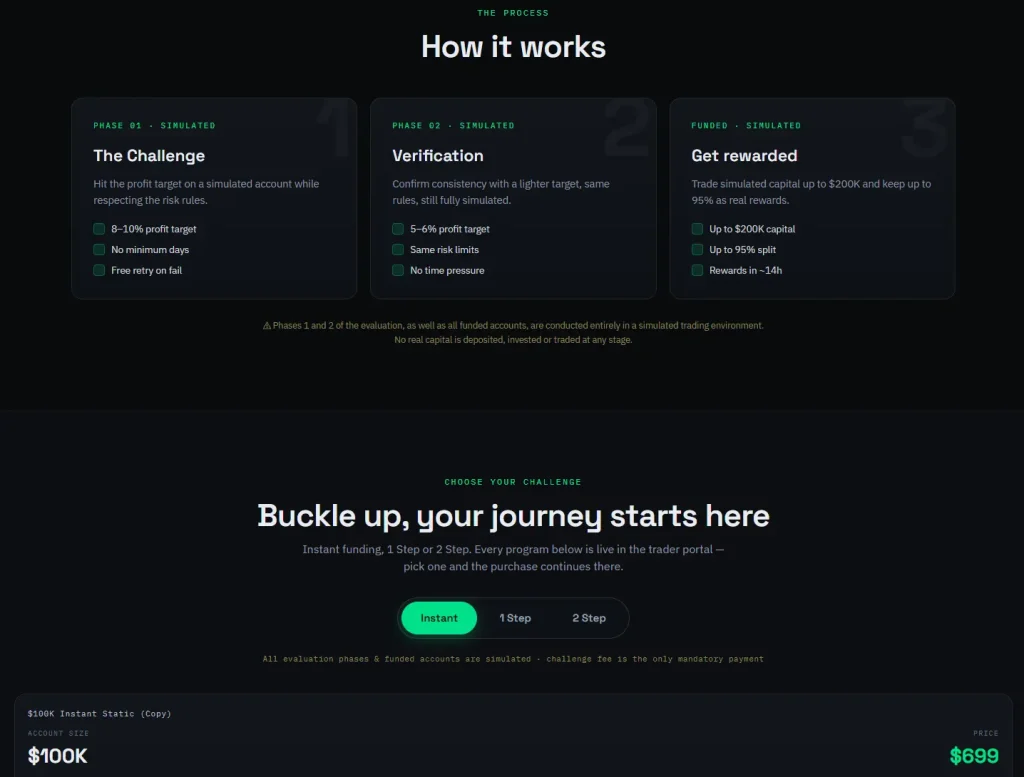 Leofins is not a strict no-minimum-day option: its published CFD evaluation rules require at least two trading days per phase. It is included as a useful comparison for traders who are willing to accept a short activity requirement in exchange for a choice of evaluation formats and no fixed maximum completion period.
The firm offers Core 2-Step, Edge 1-Step, and Starter 3-Step. Core uses targets of 7% and 4% across two phases, with a 5% daily loss limit and a 10% static maximum loss. Edge has one 8% target, a 4% daily loss limit, and a 7% static maximum loss. Starter uses three targets of 6%, 4%, and 4%, alongside a 4% daily loss limit and an 8% static maximum loss.
All three routes require at least two trading days in each evaluation phase, but there is no fixed maximum period for completing the evaluation. That means a trader can take a measured approach rather than rushing to finish before a challenge deadline, as long as the account remains within the firm’s rules and inactivity requirements.
This distinction can matter in practice. A trader who reaches the target on the first day cannot finish the evaluation immediately, because the two-day minimum still applies. However, there is no need to manufacture extra trades across a long calendar period simply because the evaluation has a fixed expiry date.
The payout schedule also differs by program. The first payout is listed at 10 days for Core and Edge, and 14 days for Starter, followed by weekly payouts under the published program details. These payout intervals should not be confused with the evaluation’s minimum trading days.
Review the current rules at https://leofins.com/ before purchasing. Confirm the exact account format, daily loss limit, maximum drawdown, minimum-day requirement, and funded-stage conditions. The evaluation and resulting funded account are simulated, and performance rewards depend on the program agreement and compliance with its rules.
What to compare: Whether the two-day minimum per phase suits your strategy, how the selected route calculates losses, and when the first reward can be requested.
How to Choose a Program Without Unnecessary Trading Days
The right choice depends on why you want to avoid minimum trading days. If your goal is to complete an evaluation as soon as your strategy reaches its target, focus on programs that explicitly remove the requirement during the challenge. The5ers Hyper Growth and FundingPips 2 Step Pro are examples worth investigating, while FTMO Futures has consistency conditions that affect the minimum time to pass.
If your main concern is being forced to trade after funding, FundedNext’s policy may be more relevant. Its funded accounts do not require a set number of active days, although its evaluation phases have their own minimum-day rules.
Before paying, compare these points:
- Evaluation stage: Confirm that the no-minimum-day rule applies before funding, not only afterward.
- Consistency conditions: Check whether a large profitable day can delay completion or affect eligibility.
- Daily and maximum loss: Understand how losses are calculated and whether open-position equity counts.
- Time limits and inactivity: No maximum evaluation period does not mean the account remains active without trading forever.
- Fees and subscriptions: A flexible timeline can still become expensive if monthly charges continue.
- Payout eligibility: Review profitable-day requirements, payout cycles, caps, and verification procedures.
- Market compatibility: Choose a program that supports the instruments and trading style you have already practiced.
A no-minimum-day rule is useful only when the rest of the program fits your strategy. It should not encourage you to increase position size or force a quick result.
Frequently Asked Questions
Can a prop firm challenge be passed in one day?
Sometimes, but not always. The program must allow completion without a multi-day minimum, and the trader must satisfy the profit target, consistency requirements, and all risk rules. A firm may still require additional review before confirming the result.
Does no minimum trading days mean there is no time limit?
No. These are separate rules. A challenge can have no minimum trading days but still have a maximum duration. Conversely, a program can have an unlimited completion period and still require a minimum number of active days.
Why do some firms require minimum trading days?
Minimum-day rules can encourage traders to demonstrate performance across more than one session rather than relying on a single result. Firms may also use consistency requirements and other controls to assess how a trader reaches the target.
Are there minimum trading days after I receive a funded account?
It depends on the firm and program. FundedNext states that its funded accounts have no minimum trading-day requirement, but its challenge phases still require minimum days. Other firms may require profitable days or a minimum number of sessions before a reward request.
Is a no-minimum-day challenge easier to pass?
Not necessarily. It removes one scheduling constraint, but it does not reduce the profit target or remove the daily loss limit, maximum drawdown, consistency rules, or other restrictions. A program with no minimum days can still be difficult if its risk limits are tight.
Should I choose the firm with the fewest restrictions?
Not automatically. Rules should be evaluated as a complete set. A flexible calendar may be valuable, but it should not outweigh an unsuitable drawdown limit, expensive subscription, unfamiliar market, or payout terms that do not fit your needs.
Final Recommendation: Match the Trading Schedule to the Rules
A no-minimum-day evaluation can be useful for traders who prefer to wait for selective setups rather than trade simply to meet a calendar requirement. The5ers Hyper Growth and FundingPips 2 Step Pro are worth examining for flexibility during evaluation. FTMO Futures offers another route, although consistency requirements still affect the earliest completion time. FundedNext is particularly relevant for traders who want no minimum trading-day requirement after funding.
Leofins is a different kind of option: it requires at least two trading days per evaluation phase but offers no fixed evaluation expiry and three CFD evaluation structures. This can suit traders who prioritize scheduling flexibility over immediate completion.
Before choosing, verify the current program terms and consider how the profit target, drawdown rules, minimum days, inactivity policy, and payout conditions interact. The best evaluation is not necessarily the one with the fewest calendar restrictions; it is the one that supports a tested strategy without encouraging unnecessary risk.
Prices and conditions are current as of October 2026.
Risk disclaimer: Proprietary trading evaluations involve financial risk. Challenge fees may be lost if an evaluation is unsuccessful or program rules are breached. Simulated trading and funded-program results do not guarantee future performance or income. Review the current terms carefully and never spend money you cannot afford to lose.